What are magic mushrooms?
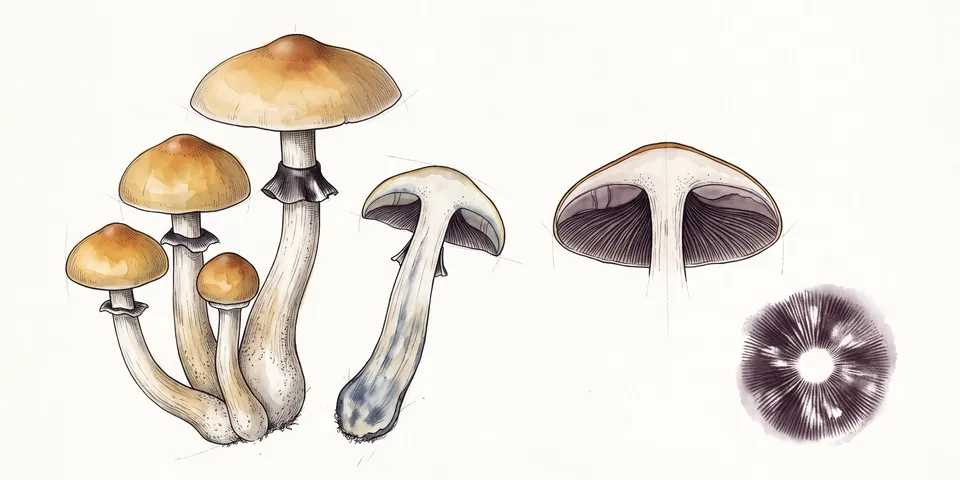
Magic mushrooms are fungi that contain psilocybin, a compound the body converts into psilocin, which acts mainly on the brain's serotonin 5-HT2A receptors to change perception, mood and thinking. They grow wild on several continents, the most commonly cultivated species is Psilocybe cubensis, and potency varies far more than most people expect.
On this page
- Active compounds
- Psilocybin (a prodrug) and psilocin (the active form)
- How it acts
- Psilocin activates serotonin 5-HT2A receptors
- Most cultivated species
- Psilocybe cubensis
- Telltale sign
- Many psilocybin mushrooms bruise blue when handled
- Federal status
- Schedule I controlled substance
Psilocybin and psilocin
Psilocybin itself is a prodrug. After you swallow it, enzymes remove a phosphate group and convert it into psilocin, the compound that actually acts on the brain. Psilocin is a partial agonist at serotonin 5-HT2A receptors; in imaging studies, the intensity of the experience tracked how many of those receptors psilocin occupied, up to about 72%. Most psilocin is then processed by the liver and excreted in urine within about a day.
The blue bruising many people associate with "magic mushrooms" comes from psilocin oxidizing when the mushroom's tissue is damaged. It's a useful sign but not proof: some toxic mushrooms also change color, and identifying wild mushrooms is risky.
The main species
- Psilocybe cubensis: the species most often cultivated, with dozens of named varieties such as Golden Teacher and Penis Envy. See our strains guide.
- Psilocybe cyanescens: a wood-loving species found in the Pacific Northwest and elsewhere, generally stronger than cubensis.
- Psilocybe azurescens: among the most potent species recorded.
- Psilocybe semilanceata ("liberty cap"): a small grassland mushroom common in Europe and the Pacific Northwest.
Why potency varies so much
A 2022 study that measured 226 individual mushrooms from 82 collections called psilocybin content "extremely variable," both between species and within the same species. Psilocybe cubensis samples ranged from about 0.65 to 3.5 milligrams of psilocybin per gram of dried mushroom, while P. cyanescens reached nearly 14 mg per gram. A 2024 study of five cubensis strains found average total tryptamine content between about 0.9% and 1.4% by weight, with differences between strains and between mushrooms of the same strain. In practice, two mushrooms that look alike can differ several-fold in strength.
How many people use them?
- In the 2022 National Survey on Drug Use and Health, 12.3% of U.S. adults reported having used psilocybin at some point, up from 11.4% in 2021.
- In the Monitoring the Future panel, past-year hallucinogen use (which includes psilocybin) reached 9% of adults ages 19 to 30 and 4% of adults 35 to 50 in 2023, continuing a five-year climb.
Is it legal?
Psilocybin and psilocin are Schedule I under federal law. Oregon and Colorado allow adult use within state systems, New Mexico is launching a medical program, and more than 30 cities and counties treat personal possession as a low police priority. See the 50-state law map.
Magic mushrooms vs. Amanita "mushrooms"
Many products sold as "mushrooms" in shops contain Amanita muscaria, which has different chemistry (muscimol and ibotenic acid) and different risks. They are not magic mushrooms. See Amanita gummies.
Frequently asked questions
What's the difference between psilocybin and psilocin?
Psilocybin is the compound stored in the mushroom. The body converts it to psilocin by removing a phosphate group, and psilocin is what acts on serotonin 5-HT2A receptors in the brain to produce the effects.
Why do magic mushrooms turn blue?
When the mushroom is damaged, psilocin oxidizes and forms blue compounds, so many psilocybin species bruise blue. Blue bruising alone isn't a safe way to identify wild mushrooms; some dangerous species can be confused with psilocybin mushrooms.
Are some magic mushrooms stronger than others?
Yes, by a lot. Lab studies find large differences between species, between strains of the same species and even between individual mushrooms. Psilocybe cyanescens and P. azurescens are generally much stronger than P. cubensis.
Sources
- Dinis-Oliveira, metabolism of psilocybin and psilocin, Drug Metabolism Reviews, 2017.
- Madsen et al., psilocybin occupancy of brain 5-HT2A receptors, Neuropsychopharmacology, 2019.
- Gotvaldová et al., psilocybin and psilocin content in Psilocybe mushrooms, International Journal of Molecular Sciences, 2022.
- Goff et al., tryptamine content of Psilocybe cubensis strains, Analytica Chimica Acta, 2024.
- Leas et al., research letter citing NSDUH psilocybin prevalence, American Journal of Preventive Medicine, 2024.
- Cannabis and hallucinogen use among adults remained at historic highs in 2023, NIDA, 2024.
- 21 CFR 1308.11, Schedule I, eCFR.